
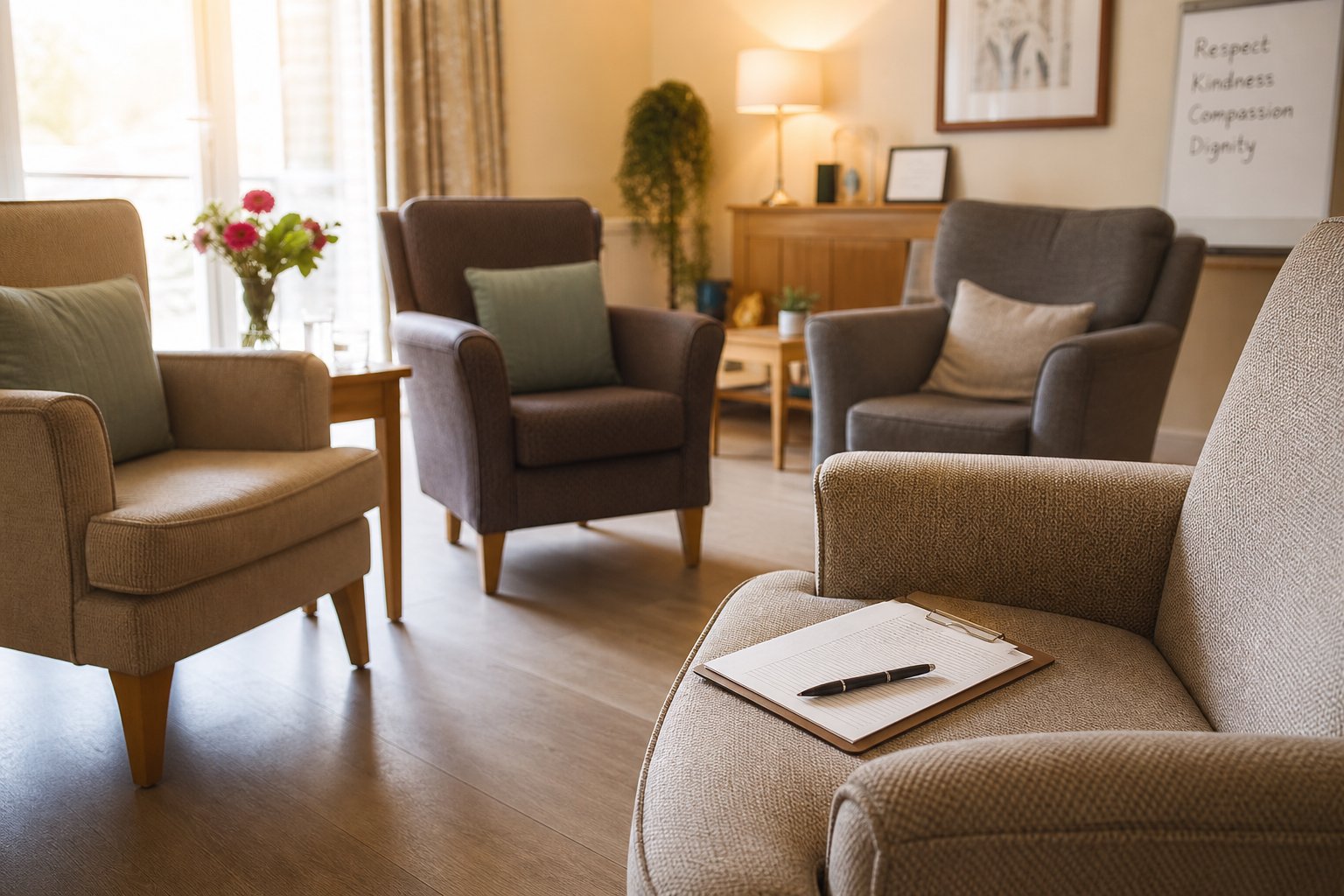
Here’s the honest version: if your service needs advance warning to look its best, that’s worth paying attention to. The goal isn’t to be “inspection ready” — it’s to run a service that looks the same on any day, at any time, because the care is genuinely good.
Let’s Be Honest About This
Care providers know that CQC can arrive without notice. Local authority commissioners can conduct unannounced monitoring visits. Families can walk in at any time. And yet the phrase “prepare for an unannounced visit” persists.
That tension tells you something important. Not that people are hiding problems — most aren’t — but that there’s often a gap between “how things are on a good day” and “how things are every day.” Closing that gap is what person-centred care actually means.
What a Trained Eye Notices in the First Ten Minutes
Regulators and independent reviewers don’t just read files. They observe. Here’s what stands out — for better or worse:
The atmosphere. Is the environment calm or rushed? Do staff greet visitors naturally, or does a wave of tension go through the building? Do residents look settled — or like the furniture has just been rearranged?
Sensory signals. Does the building smell clean, or heavily masked with air freshener? Is the temperature comfortable? These small things reveal more about daily reality than any quality report.
Staff interactions. Are staff engaging with residents — making eye contact, using first names, genuinely listening? Or are they clustered around a desk? When a resident asks for something, how quickly does someone respond?
The Details That Tell the Real Story
Person-centred care lives in the details. These are the things that reveal whether a service truly puts people first:
🍽️ Food, Mealtimes & Nutrition
Does the menu match what’s actually being served? More importantly — are dietary requirements, allergies and personal preferences being genuinely honoured? Is Mrs. Thompson getting the soft diet she needs, or the same meal as everyone else? Is there a choice, or is it one plate for all?
Look beyond the menu. Is the dining area warm and welcoming, or institutional? Are there little touches that make mealtimes feel human — a food cart, a tuck shop, a choice of where to sit? Residents who lived through the 1950s, ’60s, ’70s — do they see anything in that dining room that connects to their own history? A mural. A familiar brand. Music they recognise. These things matter enormously.
🏠 The Environment
Is the call bell within reach? Are drinks accessible throughout the day, not just at mealtimes? Is the activities board showing today’s date or last week’s? Are communal areas lived-in and personalised, or clinical and bare?
A care home should feel like someone’s home — because it is. Not a sterile corridor with numbered doors. The question isn’t “is it clean?” The question is “would you want your mum to live here?”
📋 Documentation
If a care plan says a resident needs repositioning every two hours, there should be evidence it’s happening — not just evidence it was recorded. There’s a difference, and experienced reviewers know it.
💬 What Staff Know
Can staff talk about the people they care for as people? Not recite from a file — genuinely tell you what makes someone smile, what calms them when they’re distressed, what’s changed recently. A staff member who truly knows their residents is the strongest evidence of good care.
The Right Question to Ask
Stop asking “Are we ready for an unannounced visit?” and start asking: “If someone spent a full day living the life of one of our residents — eating what they eat, sitting where they sit, waiting when they wait — would they feel safe, valued and genuinely cared for?”
If the honest answer is yes — every shift, every corridor, every mealtime — you don’t need to prepare for anything. You’re already there.
If the answer is “mostly, but…” — that’s not failure. That’s the starting point for a conversation about how to make good care even better. And that’s exactly where independent oversight adds the most value.
Leave a Reply